Setting the Scene for South African Roads
South Africa, known as the Rainbow Nation, offers stunning landscapes and busy urban corridors. Driving the country’s extensive road network is one of the most rewarding ways to experience its diversity, from the coastal sweeps of the Garden Route to the vibrant heart of Gauteng. As any senior relocation specialist will tell you, however, a successful move depends on getting the administrative parts right, early.
This guide helps long-term visitors, expats and new residents navigate the two things that trip newcomers up most: getting a legal South African driving licence, and registering and licensing a vehicle. It is built around practical steps and deadlines that carry penalties so that you can settle in without falling short of the law.

Legal Disclaimer: This article is for general informational guidance only. It is not legal advice and does not guarantee the outcome of any application. Requirements, fees, and procedures change and are set by the Department of Transport and the Road Traffic Management Corporation (RTMC). Always confirm the latest details with an official source or your nearest Driving Licence Testing Centre (DLTC) before you travel to one.
The governing framework for South African roads is the National Road Traffic Act, 1996 (Act 93 of 1996), which sets the standards for driver licensing, vehicle registration, and road safety.
Can You Drive on Your Foreign Licence?
Yes, you may drive in South Africa on a valid foreign driving licence, subject to a few conditions. There is no fixed expiry on this right while your foreign licence remains valid; the obligation to convert only arises once you obtain permanent residence (see below).
- Licence in English: If your licence is printed in English, you are good to go and may drive legally.
- Licence not in English: Carry an International Driving Permit (IDP) alongside your licence. The IDP is a recognised translation that prevents confusion at roadblocks.
- Always carry both: An IDP is a translation, not a replacement. Your original licence and the IDP must be carried together.
How to Get an International Driving Permit
Obtain your IDP from the authorised automobile association in your home country before you travel, as it generally cannot be issued once your home licence is far away. In the United States, for example, the American Automobile Association (AAA) is the body authorised by the U.S. Department of State to issue IDPs; you can apply in person or by mail with your valid licence, two passport photos, and a small fee. Other countries have equivalent motoring associations. Apply well in advance, as processing times vary.
Two Routes to a South African Licence
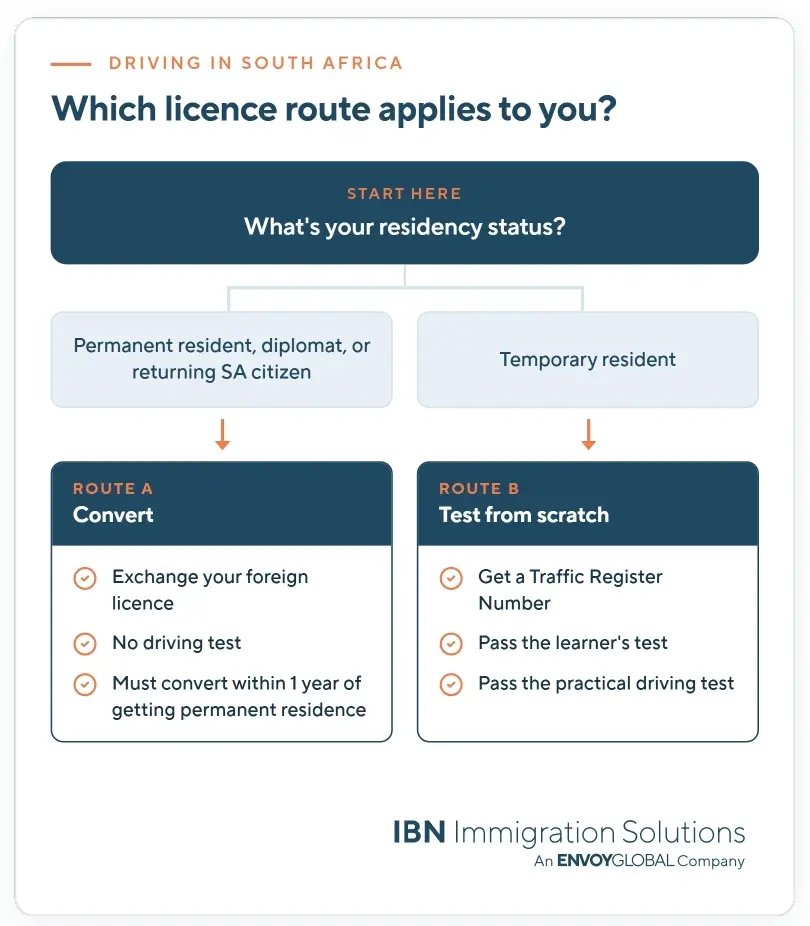
This is where most online guides get confused. There are two completely different processes, and which one applies depends on your residency status. Choose the right route before you visit a DLTC (Drivers License Testing Centres).
| Your situation | Which route applies |
| Permanent resident, diplomat, or South African citizen returning with a foreign licence | Route A – Convert (exchange) your existing licence. No driving test. |
| Temporary resident who wants a South African licence (or whose foreign licence is expiring) | Route B – Apply from scratch by testing. Learner’s and driving tests required. |
Route A – Converting (Exchanging) Your Foreign Licence
Conversion is available to holders of permanent residency or diplomatic status, and to South African citizens returning from abroad with a foreign licence. Importantly, the conversion must be completed within one year of obtaining permanent residence. Miss the 12-month deadline and the foreign licence is no longer valid for driving in South Africa. No driving test is required, because competence is treated as already established.
Quick requirements checklist
- Identification: The licence must carry a photograph and signature.
- Language: The licence must be in English, or accompanied by a certified translation from a competent authority such as an embassy or consulate.
- Validity: The licence must be valid and current on the application date. Expired licences generally cannot be converted.
- Residency proof: You must show the licence was obtained while you were not a South African resident (old passports or visas help).
- Letter of Validity: An official letter from the issuing authority or embassy confirming the licence’s authenticity and class.
A useful nuance: a Letter of Validity is what you need to enter the South African system, whereas a Letter of Entitlement is what you would need when leaving South Africa. They are not interchangeable. You can also save time by having the required eye test done by a private optometrist in advance. The certificate must be no older than three months and can replace the test at the DLTC.
Step-by-step conversion process
- Complete the forms: the DL1 form and an NCP form. The DL1 may be colour-coded depending on the centre.
- Provide biometrics: fingerprints plus four black-and-white ID photographs.
- Pay the fee: around R250.00 by Mastercard or Visa; cash is not accepted (fees are subject to change).
- Surrender the foreign licence: it is handed over when your South African licence is issued.
- Receive a temporary permit: valid for six months while the permanent card is produced (production delays are common, see the 2026 section).
Route B – Getting a South African Licence by Testing
If you hold temporary residency and want a South African licence, you generally cannot convert you must apply from scratch, the same way a first-time South African driver does. The path is: get a Traffic Register Number, pass the learner’s test, then pass the practical driving test.
Step 1- Obtain a Traffic Register Number (TRN)
A foreign national without a South African ID needs a TRN before applying for a licence (the same number is also used for vehicle ownership). Apply at your local registration office with:
- TRN application form
- Two ID photos
- A copy of your valid visa
- Proof of address
- Optional supporting documents: proof of employment, payslips, or marriage certificate
There is no fee for the TRN application.
Step 2 -Apply for a Learner’s Licence
Visit your local traffic department with your passport, a valid visa, a TRN certificate, the application form, and a payment card (around R68, subject to change). Study using the K53 app or booklets, pass the written test, pay the balance, and book your learner’s test date.
Step 3 – Take the Learner’s Test
Bring your passport, payment card, booking form, and the fee (around R33, subject to change). Passing earns a Learner’s Licence valid for two years, within which you must pass the practical driving test.
Step 4 – Pass the Practical Driving Test
Book your driving test at a DLTC. Most applicants use a registered driving school for practical experience and to learn the strict K53 testing method. Passing the test earns your South African Credit Card Format (CCF) licence.
Understanding South African Licence Codes
South Africa uses a distinct coding system. The code on your licence determines what you may legally drive. The most common is the Code B.
| Code | Vehicle description | Typical usage |
| A1 | Motorcycles with engines not exceeding 125cc | Small scooters / commuter bikes |
| A | Motorcycles with engines exceeding 125cc | All motorcycles |
| B | Light Motor Vehicles (GVM under 3,500kg) | Standard passenger cars and small vans |
| EB | Light Motor Vehicle under 3,500kg towing a trailer | Cars towing caravans or heavy trailers |
| C1 | Heavy Motor Vehicles, GVM 3,501kg–16,000kg | Large delivery trucks / high-payload bakkies |
| C | Heavy Motor Vehicles, GVM over 16,000kg | Extra-heavy trucks and buses |
Note: an automatic-only licence restricts you from driving manual vehicles.
Renewals: The “Cannot Renew From Abroad” Warning
The South African CCF licence cannot be renewed from outside the country. Renewal requires an eye test and fingerprints taken in person at a DLTC in South Africa. If your card expires while you are overseas, the renewal has to wait until you return. Plan trips accordingly.
Registering a Vehicle in South Africa
Vehicle ownership involves two separate things. Registration records ownership on the eNaTIS system; licensing is the annual fee that pays for the windscreen disc. You need both.
The 21-Day Rule
A vehicle must be registered and licensed within 21 days of purchase, or you face penalties. On a financed purchase, the bank is the titleholder while you are listed as the owner.
The Traffic Register Number (TRN) for Ownership
Foreign nationals without a South African ID must hold a TRN before owning a vehicle (the same number used in Route B above). Requirements include:
- Valid passport and visa
- Two ID photos and proof of residence
- Letter of employment or study
- A signed affidavit stating the purpose
Documents: New vs. Used Vehicles
The paperwork depends on the vehicle’s history. Registration fees typically fall between R192.00 and R228.00, while the annual licence fee is calculated on the vehicle’s tare (weight) and province (fees subject to change).
| Document | New vehicle | Used / pre-owned |
| Application Form (RLV) | Yes | Yes |
| Identification (Passport / TRN) | Yes | Yes |
| Proof of Residence | Yes | Yes |
| Manufacturer’s Certificate | Yes | No |
| Previous Registration Certificate | No | Yes (original from seller) |
| Proof of Purchase (Invoice) | Yes | Yes |
| Roadworthy Certificate (CoR) | No | Yes (if applicable) |
| Change of Ownership (NCO) | No | Yes (yellow form from seller) |
Understanding Roadworthiness
Roadworthiness is about safety compliance, not a full service. A Certificate of Roadworthiness (CoR) is required before a used vehicle can be registered in a new owner’s name.
When is a CoR Required?
A roadworthy test is not an annual requirement for every private car, but these situations trigger one:
- Change of ownership: mandatory for all private vehicles when ownership transfers.
- Transport for reward: e-hailing (Uber/Bolt) and taxi vehicles must be tested every 12 months.
- Heavy vehicles: any goods vehicle with a GVM over 3,500kg needs an annual test.
- Buses: must undergo a roadworthy inspection every 6 months.
The Inspection Checklist
The inspection takes roughly 20–30 minutes and covers the critical safety areas:
- Braking system: efficiency and balance of pads, discs and handbrake.
- Tyres: no damage, and a minimum tread depth of 1.6mm across the tyre.
- Steering and suspension: wheel alignment, shock absorbers and steering play.
- Visibility: no major windscreen cracks; functional wipers.
- Lights and electrical: headlights, indicators, brake lights and battery integrity.
- Structure: chassis free of serious rust, corrosion or structural damage.
A roadworthy certificate is valid for 60 days from issue for registration purposes.
The 2026 Reality: Licence Card Delays and Pending Reforms
If you read elsewhere that a new “smart” licence card and a raft of new rules took effect in early 2026, treat those claims with caution. The reality is slower and more relevant to plan around.
New card still not in circulation. South Africa’s long-promised new licence card has not been launched. The roughly R900-million tender for a new printing system was set aside by the High Court in early 2026 and ordered to be re-advertised, so the country continues to rely on its single, decades-old printer. Expect the current card format for the foreseeable future.
Production backlogs and temporary licences. Due to the aging printer, card turnaround has stretched to several weeks. If you have applied and your old card is expiring, keep your application receipt in the vehicle. To keep drivers legal during the backlog, the Department of Transport waived the fee for temporary driving licences. Ask for one at your DLTC.
Proposed 5-to-8-year validity (not yet law). The Department of Transport plans to extend card validity from five to eight years, but this is still at the policy stage, targeted for Cabinet around 2027 and Parliament thereafter. It is not in force, so renew on your current five-year cycle.
Vehicle-licensing requirement changes. New national requirements for vehicle registration and licensing (including stricter ID documentation at offices) were due in late 2025 but were delayed pending clarification. Check for an updated directive before assuming new paperwork rules apply.
Bottom line: build extra time into any renewal, apply early, and confirm the current position with an official source rather than relying on rollout dates that keep moving.
Tips for Foreigners Driving in South Africa
Rules of the Road
- Keep left: driving is on the left, and vehicles are right-hand drive.
- The “robot”: local slang for a traffic light. If a robot is out (which is common during power outages), treat the intersection as a four-way stop.
- Four-way stops: first-come, first-served. The first vehicle to come to a complete stop has right of way.
- Speed limits: typically 120km/h on freeways, 100km/h on rural roads, and 60km/h in urban areas.
Safety Precautions
Safety awareness is part of the South African driving experience, and a little vigilance keeps journeys stress-free. Keep doors locked and windows up at intersections, and store bags and valuables in the boot to reduce the risk of “smash and grab” incidents. Manually check that your doors actually locked after using a remote, since signal jamming is a known tactic in parking areas. Avoid picking up hitchhikers or stopping in deserted spots to use a phone, and take care driving at night in poorly lit areas, where potholes or stray livestock are harder to spot.
Useful Emergency Contacts
These numbers can only be dialled while in South Africa – the international code however, is “+27”.
| Service | Number |
| Police (SAPS) | 10111 |
| Ambulance / Fire | 10177 |
| General mobile emergency | 112 |
| ER24 (private medical) | 084 124 |
| Netcare 911 (private medical) | 082 911 |
Frequently Asked Questions
Can I drive in South Africa on my foreign licence?
Yes, as long as your licence is valid. If it is not in English, carry an International Driving Permit (IDP) alongside it. There is no fixed time limit; while your foreign licence is valid, the one-year conversion deadline applies only once you obtain permanent residence. .
Can a temporary resident convert a foreign licence to a South African one?
Generally no. Conversion (exchange) is available to permanent residents, diplomats, and returning South African citizens. A temporary resident who wants a South African licence applies from scratch by passing the learner’s and driving tests (Route B above).
How long do I have to convert my licence after getting permanent residence?
One year. After 12 months of permanent residence, an unconverted foreign licence is no longer valid for driving in South Africa.
Do I need to take a driving test to convert my licence?
No. Conversion does not require a driving test; your competence is treated as already established. Testing applies only to Route B (applying from scratch).
Can I renew my South African licence from overseas?
No. Renewal needs an eye test and fingerprints taken in person at a DLTC in South Africa. If your card expires while you are abroad, you must wait until you return.
How long does it take to get the physical licence card?
Due to national printing backlogs, the card may take several weeks to arrive. You receive a temporary permit (currently fee-waived) to drive legally in the meantime.
What is a TRN and do I need one?
A Traffic Register Number is required for foreign nationals (without a South African ID) before applying for a licence by testing or registering a vehicle. The application itself is free.
How quickly must I register a vehicle after buying it?
Within 21 days of purchase, or you face penalties. Registration records ownership; licensing is a separate annual disc fee.
Conclusion
Navigating the South African system rewards patience and a proactive mindset. Two deadlines do most of the damage if missed: the 21-day vehicle registration rule and the one-year conversion deadline for permanent residents. Plan around them, apply early to absorb the ongoing card-printing delays, and verify fees and rules with an official source, because the regulatory environment keeps shifting.
Relocating to South Africa and want the licence and vehicle admin handled correctly the first time? IBN Immigration Solutions assists foreign nationals with residency and the practical steps that follow. Get in touch to make your move smoother.
Written by Kyle Noel Glover