
The Common Misconception About Switching Visas
A pervasive assumption remains among foreign nationals that South Africa’s immigration system allows for the fluid switching of visa categories while remaining within the Republic. Many visitors arrive under the impression that securing employment or a place at a learning institution enables them to adjust their status at a local VFS office.
Current administrative practice, rooted in the Immigration Act, is deliberately restrictive on this point. The core legal principle is that a change of status must normally be applied for from a South African diplomatic mission in the applicant’s home country or country of residence – keeping the application offshore is how the Department of Home Affairs (DHA) preserves consular oversight of who changes status and on what basis.

The Legal Framework for Understanding Section 10(6)
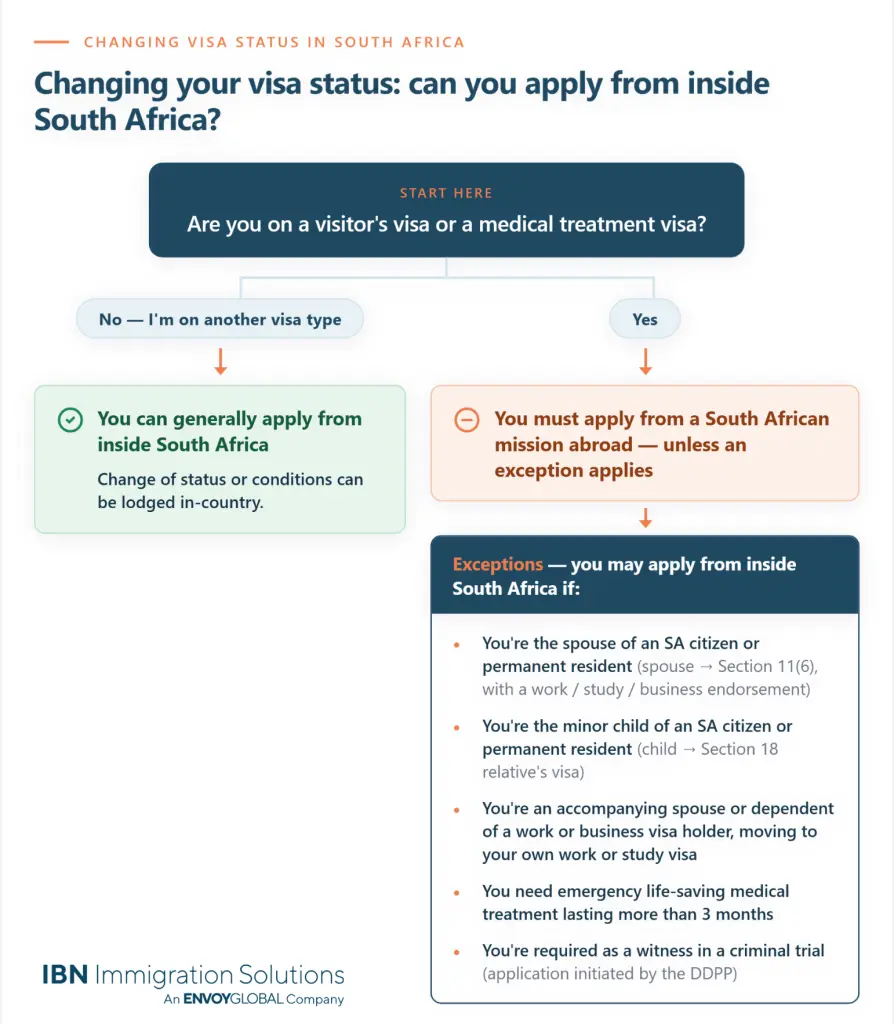
The primary legislation governing these transitions is Section 10(6) of the Immigration Act. This section establishes a general prohibition on changing one’s status from a visitor visa or a medical treatment visa while in South Africa.
As a matter of technical precision, applicants must distinguish between two legal concepts:
- Change of Status: This refers to the transition of a person’s legal status or visa type (e.g., from a Visitor’s Visa to a General Work Visa).
- Change of Conditions: This refers to adjusting the specific requirements or terms attached to a current visa (e.g., changing from School X to School Y while remaining on a Study Visa).
The General Rule: Section 10(6) provides that a holder of a visitor’s visa or medical treatment visa may not apply for a change of status while in the Republic, except in prescribed exceptional circumstances. The bar turns on the type of visa held, not on its duration – unless a specific statutory exception applies, a visitor must leave the Republic to regularise their stay.
Statutory and Judicial Exceptions to Section 10(6)
Under Regulation 9(9) and Section 10(6)(b), the law recognises narrow exceptional circumstances where a visitor may apply for a change of status from within the Republic. These categories include:
- Spouses and Minor Children of SA Citizens or Permanent Residents: Guided by the Constitutional Court’s rulings in Nandutu (2019) and Rayment/Anderson (2023), the law recognises the imperative to protect family unity. The pathway differs by relationship: a spouse applies for a Section 11(6) visitor’s visa, which carries an endorsement to work, study, or run a business; a child applies for a Section 18 relative’s visa. Both may be applied for from within South Africa.
- Accompanying Spouses and Dependents of Work or Business Visa Holders: Spouses and dependent children already in the country on accompanying status may apply to transition to their own independent work or study visa..
- Emergency Medical Care: Individuals requiring life-saving medical treatment for a period exceeding three months.
- Criminal Trial Participation: Individuals are required to testify as witnesses in a criminal trial, provided the Deputy Director of Public Prosecutions initiates the application.
Realistic Pathways for Transitioning to Work or Study Visas
For those eligible for a transition, planning must account for specific thresholds and onerous timelines:
- Critical Skills Work Visa: Requires qualifications evaluated by the South African Qualifications Authority (SAQA), a process that takes 3–5 months, and registration with a SAQA-recognised professional body.
- General Work Visa: This pathway is now adjudicated under South Africa’s points-based system and includes SAQA evaluation as part of the points calculation. The former Department of Labour (Department of Labour) recommendation requirement no longer applies. Instead, applicants must score at least 100 points against DHA’s (Department of Home Affairs) criteria, which may include factors such as occupation, qualifications, salary, work experience, and language ability. While this removes the old DoL bottleneck, the category remains document-heavy and subject to DHA processing delays.
- This pathway is now adjudicated under South Africa’s points-based system, with SAQA evaluation feeding the points calculation. The former Department of Labour (DoL) recommendation requirement no longer applies. Instead, applicants must score at least 100 points against DHA’s criteria – factors such as qualifications, salary, work experience, and language ability. While this removes the old DoL bottleneck, the category remains document-heavy and subject to DHA processing delays.
- Study Visa: Issued for approved institutions and permits part-time work of up to 20 hours per week.
- Section 11(6) Spousal Visa: Technically a Visitor’s Visa with work authorisation. It is for spouses of SA citizens/PR holders and is renewable.
Financial Thresholds: Applicants must demonstrate sufficient financial means, currently defined as a minimum of R3,000 per person per month for visitor visa applications and R8,500 for long-term relative visa applications.
Critical Risks of the 60-Day Trap and Overstay Consequences
In 2025, adjudication shifted toward a rigid, mechanical approach to filing deadlines. Applications that fall even marginally late are increasingly refused, often without any engagement with the surrounding circumstances. The deadline is strict and falls well before expiry: under Regulation 9(5)(a), an application to change status must be submitted no less than 60 days before the current visa expires, and Regulation 9(8)(c) applies the same cut-off to extension applications. Sixty days before expiry is therefore the filing deadline, not the start of a grace period – and it is the applications lodged inside that final 60-day window that are now being refused.
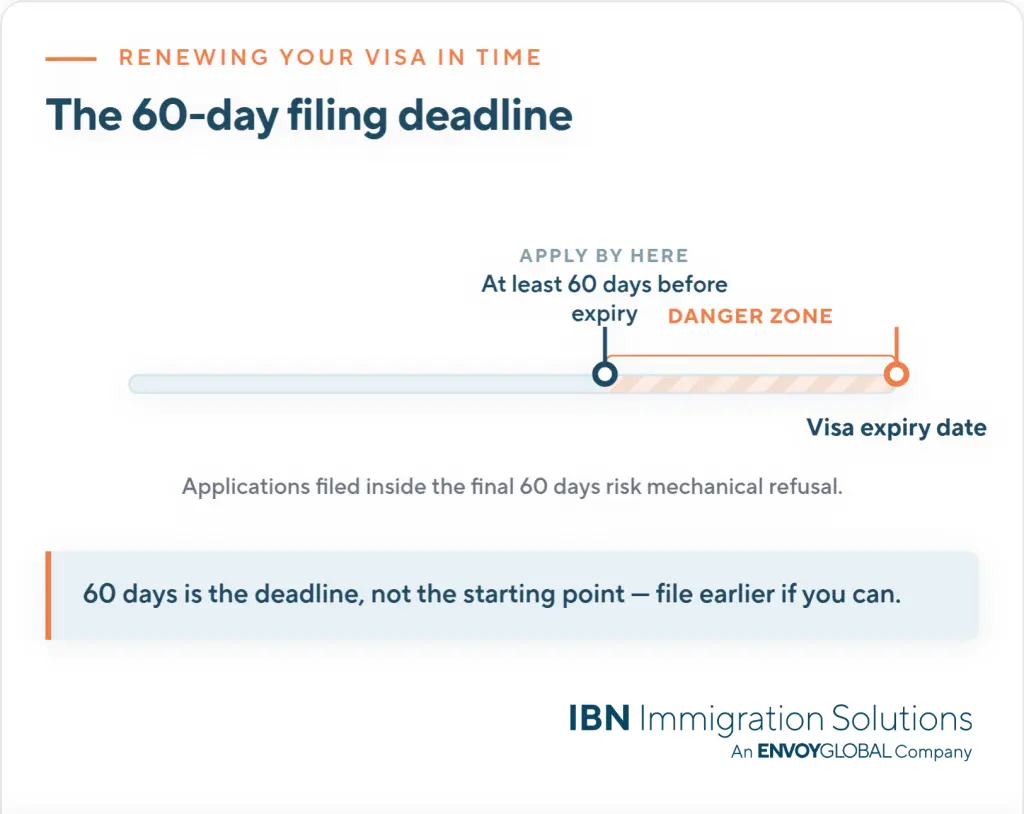
These refusals follow a pattern. Adjudicators are frequently issuing rejections using identical, formulaic wording, stating that “the applicant did not submit his/her application no less than 60 days before the expiry date of his/her visa”. From a policy and constitutional perspective, this strict, literal application of timelines is legally fragile. Section 33 of the Constitution, together with the Promotion of Administrative Justice Act (PAJA), requires administrative decisions to be lawful, reasonable, and procedurally fair. This includes taking into account real‑world constraints, such as persistent shortages in VFS appointment availability, which may prevent otherwise diligent applicants from filing within rigid deadlines. The absence of such contextual consideration exposes these refusals to potential legal challenge.
Perhaps the most severe consequence arises when an applicant fails to submit a pending application before their visa expires. In such cases, the individual is declared an undesirable person (ban) upon departure from South Africa. While it is possible to apply for a lifting of this ban by demonstrating good cause, the process is far from immediate: at the time of writing, resolution takes upwards of 12 months. During this time, the individual remains barred from returning to the country, often with significant personal, professional and financial implications.
Together, these trends underscore the importance of proactive planning and early filing. The so‑called 60‑day trap has become one of the most critical risk areas in South Africa’s immigration system, where procedural missteps rather than substantive ineligibility can have long‑lasting and disproportionate consequences.
Best Practices for Proper Planning
To ensure compliance and avoid the risk of being declared undesirable, applicants should adhere to the following checklist:
- Determine Exception Status: Confirm if you fall under a judicial or statutory exception.
- Early SAQA Initiation: Begin the SAQA evaluation 3–5 months before any application.
- Document Legalisation: Ensure all foreign birth, marriage, and police clearance certificates are apostilled.
- Secure VFS Appointments Early: Due to scarcity, book your appointment well in advance of the 60-day filing deadline to avoid a mechanical refusal.
Disclaimer: Immigration regulations and Department of Home Affairs practices are subject to frequent changes. All eligibility and requirements must be confirmed with official government sources. This document is for informational and educational purposes and does not constitute legal advice or a guarantee of visa issuance.
Written Xabisa Mxokozeli, PR and Creative Assistant