

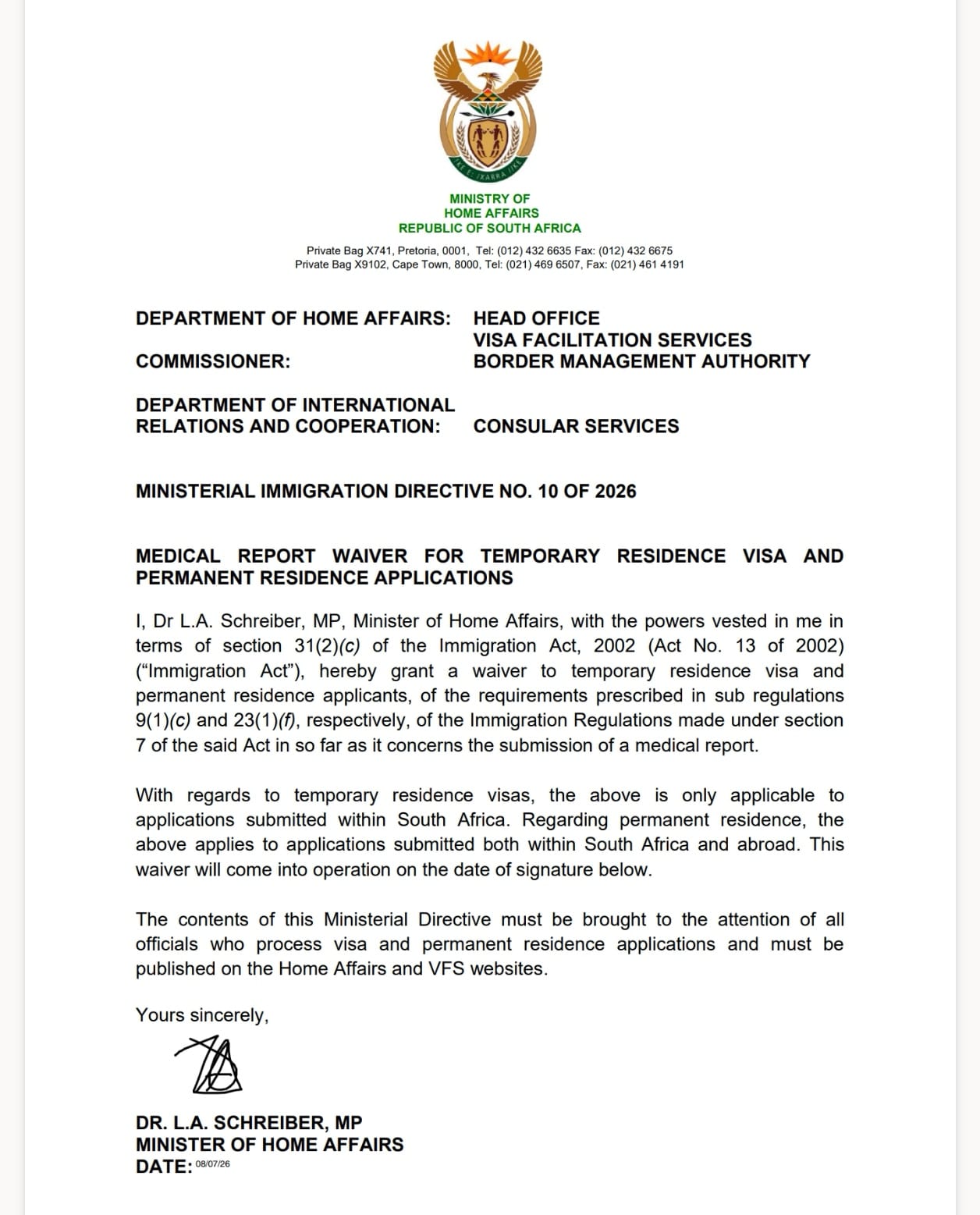
On 8 July 2026, the South African Minister of Home Affairs, Dr Leon Schreiber, signed Ministerial Immigration Directive No. 10 of 2026, waiving the requirement to submit a medical report for certain temporary residence visa and permanent residence applications. The waiver came into effect immediately upon signature; however, according to the latest update available at the time of this article, the directive appears to have been withdrawn and is expected to be replaced by a new directive due to errors on the original document.

What the Directive Says
Acting under section 31(2)(c) of the Immigration Act, 2002 (Act No. 13 of 2002), the Minister has granted a waiver of the medical report requirements prescribed in sub-regulations 9(1)(c) and 23(1)(f) of the Immigration Regulations.
In plain language: the medical report – the form completed and signed by a medical practitioner confirming an applicant’s state of health – is no longer required for the application categories covered by the waiver.
The directive instructs that the change be brought to the attention of all officials who process visa and permanent residence applications, and that it be published on the Home Affairs and VFS websites. Often, it takes some time for certain South African embassies and missions to become aware of changes made to immigration regulations, so we recommend some patience when submitting your applications.
Who the Waiver Applies To
The medical report waiver applies only to temporary residence visa applications submitted within South Africa.
If you are applying for a temporary residence visa from outside South Africa through an embassy, consulate, or VFS office abroad, you must still submit a medical report with your application. Omitting it will put your application at risk of rejection.
Permanent Residence
The waiver applies to all permanent residence applications, regardless of where they are submitted within South Africa or from abroad. In effect, permanent residence applicants worldwide can now omit the medical report from their supporting documents.
What Has Not Changed
The waiver covers only the medical report. Every other requirement remains fully in force, including:
- Police clearance certificates from countries where you have resided for 12 months or longer in the five years preceding your application.
- Proof of financial means, qualifications, employment, or relationship, depending on your visa category.
- Valid passports, prescribed forms, and category-specific supporting documents.
A shorter document checklist does not mean a lighter adjudication. Applications are still assessed against the full requirements of the Immigration Act and Regulations, and incomplete or incorrectly prepared applications remain the leading cause of delays and rejections.
Part of a Clear Deregulation Trend
Directive No. 10 of 2026 does not stand alone. It is the latest step in a steady reduction of the documentary burden on applicants:
April 2023 Directive No. 5 of 2023
The radiological report (chest X-ray) requirement was scrapped entirely in 2023, and the police clearance requirement was reduced from every country of residence since age 18, to only requiring those from five years preceding the application.
July 2026 Directive No. 10 of 2026
The health-screening documents that accompanied South African applications for decades have now been significantly reduced.
In practice, the medical report often added little substantive value to the application. Its purpose was to confirm whether an applicant suffered from serious medical conditions, but in ordinary practice this rarely became the deciding issue. Instead, the document often created technical risks: applications could be challenged or rejected because the form was not signed in black ink, the doctor’s stamp was difficult to read, or officials could not verify the medical practitioner.
Removing the requirement therefore does more than reduce cost. It also removes a common source of unnecessary adjudication errors.
What Applicants Should Do Now
If you have an application currently in preparation, review your document checklist before spending money on reports that are no longer required. And if you are applying for a temporary residence visa from abroad, do not assume the waiver covers you; it does not.
Due to the withdrawal of the directive, pending changes, we advise awaiting the release of the updated document before proceeding as if this directive is in effect; the medical report requirement was removed in principle, but applicants must wait for the replacement directive and its final scope.
Once the directive is re-released, directives take effect immediately and are implemented unevenly in the early weeks, so it is also worth confirming that the office or VFS centre handling your application is applying the new directive correctly. We will be sure to update readers of any changes in the coming days.
Written by Andreas Krensel, Senior Director of Africa and Europe