The Dual Mandate of the Modern MEA Employer
The contemporary workforce landscape in the Middle East and Africa (MEA) is shaped by two concurrent policy objectives that employers must address simultaneously. Governments across the region are tightening labour market access through localisation and nationalisation policies intended to support political stability, social cohesion, and long-term employment outcomes for citizens. At the same time, those same states are competing internationally to attract specialised technical, digital, and AI-driven skills required for economic diversification and industrial upgrading.

These objectives are not contradictory, but they do impose a dual compliance and planning burden on employers. While baseline work authorisation is becoming more restrictive, targeted immigration pathways are increasingly being used to attract skills designated as critical to national development. For employers, workforce continuity depends on aligning global talent deployment with mandatory domestic workforce development obligations.
In some African economies, outward skilled migration continues to place pressure on local labour markets and skills pipelines. Nigeria, for example, is frequently cited in policy literature as experiencing significant fiscal and productivity losses associated with skilled emigration. For multinational firms operating in MEA, the regulatory environment now requires workforce strategies that integrate foreign expertise with demonstrable local capacity-building.

The Strategic Intent of Nationalisation
Nationalisation frameworks in MEA are increasingly moving beyond fixed numerical quotas toward broader labour-market governance objectives. Regional instruments such as the SADC Labour Migration Policy Framework are designed to harmonise labour migration governance across member states, align national systems with international labour standards, and manage mobility in ways that support regional economic development.
The SADC Protocol on Employment and Labour (2014) provides the legal basis for this approach. It encourages member states to align national legislation in ways that protect the rights of migrant workers, including access to basic labour protections and, where applicable, social security coordination, while preserving the policy space to prioritise citizens in domestic employment. The framework does not create automatic labour mobility rights but establishes principles for managed migration within the region.

For employers, these instruments function as conditional access frameworks. Market entry and workforce authorisation are increasingly linked to demonstrable commitments to skills transfer, decent work standards, and long-term localisation outcomes.
The Two-Track Immigration Reality
Across MEA, work authorisation regimes now operate on a differentiated basis. General employment permits are subject to heightened scrutiny, commonly requiring evidence that a suitably qualified local candidate cannot fill the position. Labour market testing, advertising requirements, and approvals from employment authorities are standard features.
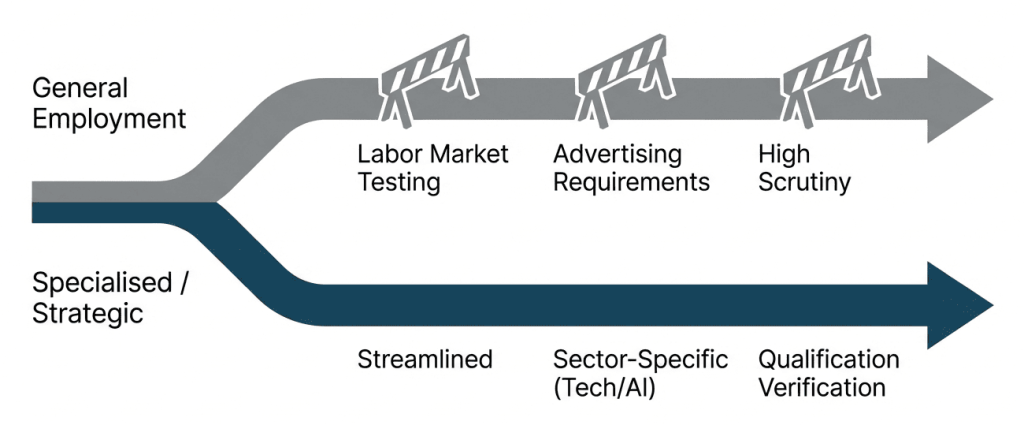
In parallel, specialised immigration categories are being streamlined for occupations and sectors identified as nationally strategic. These fast-track routes are typically limited in scope, occupation-specific, and subject to qualification and professional registration requirements.
Comparative Work Authorisation Pathways

South Africa
- General Work Visas are assessed under a points-based system (minimum 100 points) together with standard prescribed supporting documents.
- Critical Skills Visas are available for occupations listed on the gazetted Critical Skills List, subject to qualification verification and, where required, professional body registration.
Morocco
- Standard employment authorisation requires approval from ANAPEC confirming the absence of a suitable local candidate.
- Specific industrial sectors, including automotive, aerospace and renewable energy, benefit from expedited procedures for specialised roles.
Kenya
- Class D permits apply to skilled professionals or technical assistance roles aligned with national development priorities. The local understudy is imperative to the successful application of this work permit.
Localisation and Talent Deployment as a Governance Function
Localisation obligations increasingly operate as an integrated governance issue, rather than a discrete compliance task. Workforce ratios, permit volumes, and foreign national deployment are actively monitored and can affect an organisation’s operational standing with labour and immigration authorities.
In several jurisdictions, foreign employment approvals are explicitly linked to skills transfer obligations. These reporting requirements are not discretionary and form part of permit renewal and audit processes.
Effective workforce governance, therefore, requires structured monitoring of both localisation ratios and the performance of foreign experts against mandated knowledge transfer outcomes.
Digital Enforcement and Real-Time Compliance
Immigration and labour enforcement across the MEA region have been significantly strengthened through digitisation. Biometric enrolment, integrated border management systems, and electronic visa platforms now allow authorities to cross-reference immigration status, employment records, and employer filings in real time.
Systems such as biometric capture on arrival or eVisa platforms reduce administrative discretion and eliminate informal remediation practices. Incomplete or inconsistent filings are more likely to result in immediate rejection rather than conditional approval.

In South Africa, prolonged processing delays and whole administrative bottlenecks have been widely documented, with measurable economic consequences. Digital enforcement frameworks now place the responsibility squarely on employers to ensure alignment among global mobility, local HR, and legal teams.
Recurring Strategic Failures in MEA Workforce Planning
Several recurring failures continue to expose firms to regulatory risk:

Misunderstanding of Localisation
Localisation is often treated solely as a national issue, while regional economic community frameworks such as SADC and COMESA are ignored. This approach overlooks intra-regional mobility provisions and fee exemptions available to certain member-state nationals and fails to anticipate the direction of regulatory harmonisation.
No Modelling on Ratios
Global talent deployment is frequently undertaken without modelling its impact on statutory localisation ratios. Introducing foreign specialists without advance ratio analysis can trigger labour inspections or permit denials, particularly in jurisdictions with sector-specific thresholds.
Incorrect Work Authorisations

Short-term exemptions are often misused as substitutes for long-term authorisation strategies. Algeria’s Temporary Work Permit illustrates this risk. The permit is strictly non-extendable and functions only as a preliminary step toward a full work visa. Failure to transition in time can result in abrupt loss of authorisation and operational disruption.
Building a Medium-Term Regional Talent Strategy
Sustainable MEA operations increasingly depend on multi-year workforce planning aligned with national development objectives.

Understudy and succession arrangements are mandatory in several jurisdictions, including Zimbabwe and Ethiopia. In these cases, employers must identify and nominate local understudies at the outset, and supporting documentation may be required as part of the initial permit application rather than at the renewal stage. In parallel, firms are expanding the use of alternative residence and work categories where legally appropriate.
Conclusion
Employers operating in MEA face a regulatory environment defined by managed openness rather than unrestricted mobility. Access to specialised global talent is increasingly conditional on measurable contributions to domestic skills development.

Organisations that succeed integrate localisation planning, skills transfer, and immigration strategy into a single governance framework. By aligning foreign expertise deployment with structured knowledge transfer and successor development, firms can meet immediate operational needs while building compliant, resilient local workforces for the long term.
Written by Melissa Moses, Senior Immigration Manager