
From Employer Assertion to Empirical Proof
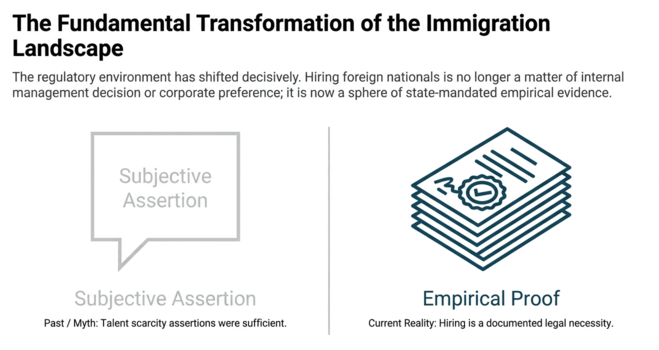
The landscape of Moroccan immigration has undergone a fundamental transformation, shifting decisively away from a system in which employers’ assertions of talent scarcity were sufficient to secure work authorisation.
In the current regulatory environment, the recruitment of foreign nationals has moved into a sphere of state-mandated empirical evidence. The primary gatekeeper in this process is the National Agency for the Promotion of Employment and Skills, commonly referred to as ANAPEC.
This agency ensures that the hiring of a foreign worker is a matter of documented legal necessity rather than a mere corporate preference or an internal management decision.

Unavailability as a Legal Status, Not an Opinion
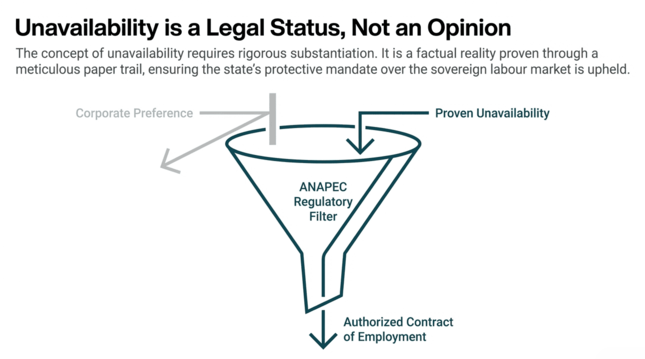
For any employer intending to integrate international talent into Morocco, the concept of unavailability must be understood as a formal legal status that requires rigorous substantiation. It is no longer a subjective opinion to be shared with the Ministry, but a reality that must be proven through a meticulous paper trail.
This evidentiary burden begins long before a contract is finalised, as the Contract of Employment requires explicit pre-authorisation. Without this approval, the recruitment process cannot legally advance, placing the onus on the firm to demonstrate, through verifiable data, that no local alternative exists.
The State’s Protective Mandate Over the Labour Market
The protection of the Moroccan sovereign labour market underpins the regulatory authority’s intervention. The state prioritises the local workforce, ensuring that Moroccan nationals are given priority in filling vacancies in the domestic economy.
This protectionist stance is a core component of national development, requiring a verifiable history of recruitment efforts to justify the introduction of foreign labour.
Consequently, ANAPEC’s approval of the CTE serves as a vital regulatory filter, designed to ensure that foreign hires fill genuine, proven gaps in the local talent pool.
Administrative Vetting and Sector Sensitivity
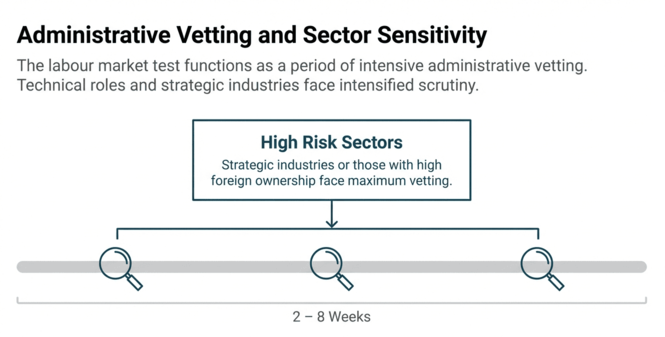
In practice, the labour market test functions as a period of intensive administrative vetting, typically lasting between 2 and 8 weeks. During this window, the authorities examine the justification for the hire with a degree of precision that often catches unprepared firms off guard.
A significant factor in this process is sector sensitivity. Industries considered strategic, or those characterised by high levels of foreign ownership, are viewed as high-risk for the displacement of local talent and therefore face intensified scrutiny. Technical or highly specialised roles frequently fail this test when employers rely on corporate reputation or candidate prestige rather than submission-ready evidence.
The Local-Search Evidence Framework
To navigate this environment, sophisticated firms must adopt a Local-Search Evidence Framework. This compliance-first methodology treats the recruitment process itself as the deliverable, rather than merely a step toward hiring.
Verifiable Outreach
Implicit within this requirement is the need to move beyond generic job postings. Employers must show documented, targeted searches that demonstrate a genuine effort to engage the local labour market.
Screening Integrity
This pillar demands comprehensive records of all local candidate assessments. Each rejection must be supported by clearly articulated technical or operational non-viability factors, creating a defensible rationale capable of withstanding government audit.
Procedural Consistency
Procedural consistency ensures that timelines, documentation, and recruitment conduct align precisely with regulatory expectations. The objective is to prove that the search was genuine, exhaustive, and completed before the CTE was ever drafted.

Downstream Risk
A vulnerability in the Moroccan immigration lifecycle lies in the transition from entry authorisation to long-term residence. While a work visa permits entry, it does not guarantee the right to remain. Weak evidentiary foundations at the ANAPEC stage frequently surface later during the application for the carte de séjour (Moroccan Residence Permit).
At this point, the employee must secure residency through the General Directorate of National Security and the relevant Prefecture of Police or Wilaya. Any inconsistency or fragility in the original ANAPEC file can result in compliance limbo, where the individual is physically present but lacks the legal standing to work on a long-term basis.

The Myth of Precedent and Common Employer Errors
Multinational firms often assume that prior approvals for a specific role establish a legal precedent. In reality, every application is a fresh assessment of the current labour market. No historical approval carries forward automatically.
Generic postings that fail to reflect granular technical requirements, combined with incomplete screening records, remain among the most common reasons for rejection. These errors typically arise from applying global hiring norms to a local regulatory framework that demands significantly higher evidentiary standards.

Strategic Workforce Planning for Long-Term Operations
For businesses planning to operate in Morocco over a three-to-five-year horizon, an immigration strategy must be embedded into workforce planning well in advance. Recruitment cannot be approached on a reactive, case-by-case basis.
Instead, a business should identify which roles are likely to remain justifiable for foreign nationals and which require sustained investment in local talent development. By flagging roles within sensitive sectors that are consistently difficult to fill, firms can begin building evidentiary files long before a hire becomes urgent.
Compliance as a Function of Record Quality
The evidentiary reality of the Moroccan system is clear: compliance is determined by the quality of the record, not the seniority of the applicant. Sustainable success is built on meticulous documentation and a deep understanding of the state’s role as custodian of the domestic workforce.
In the Moroccan context, a rigorous, defensible paper trail for every foreign hire remains an essential aspect of maintaining long-term operational stability.

Written by Melissa Moses, Senior Immigration Manager, Africa