Kenya has introduced a mandatory inbound travel health insurance requirement for foreign nationals travelling to the country under the Electronic Travel Authorisation (ETA) framework. The requirement took effect on 6 October 2026 and remains in force following the dismissal of a legal challenge on 7 October 2026.
Although much of the public discussion has focused on tourism, the requirement also affects business travellers, conference delegates and companies sending employees to Kenya for short-term assignments. As a result, employers should ensure this additional requirement forms part of their travel planning processes.
What Has Changed?
Under the new framework, eligible foreign nationals travelling to Kenya under the ETA framework must obtain inbound travel health insurance through a Kenyan insurer approved by the Insurance Regulatory Authority (IRA).
The insurance can be purchased during the ETA application or separately through the dedicated Inbound Travel Health Insurance service on the eCitizen portal. It applies regardless of whether the purpose of travel is tourism, business meetings, conferences or training.
Who Does It Apply To?
The requirement applies to most foreign nationals travelling to Kenya under the ETA framework. This includes tourists, business travellers, conference delegates and other short-term visitors.
Importantly, children are not exempt and must also obtain the required cover.
What Does the Cover Include and What Does It Cost?
The policy must provide a minimum cumulative cover of US$50,000 and is intended to ensure visitors have access to healthcare services during their stay in Kenya.
The prescribed minimum benefits are:
- US$25,000 for emergency medical transportation
- US$20,000 for medical expenses
- US$5,000 for repatriation of mortal remains
- US$1,000 for mental health treatment
- US$300 for prescribed medicines
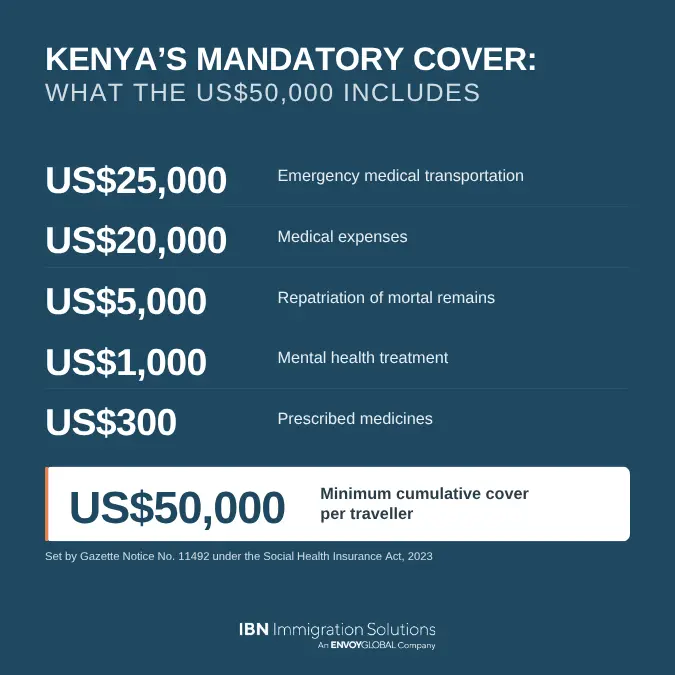
These were set by Gazette Notice No. 11492, issued pursuant to Section 26(6) of the Social Health Insurance Act, 2023, read with Regulation 70(2)(b) of the Social Health Insurance Regulations, 2024.
In practice, travellers are being directed to the Kenyan scheme. The Ministry of Health has indicated that compliant policies issued in a traveller’s home country may be uploaded through the ETA system for verification, but industry guidance points to the Kenyan policy as the operative requirement, and the position awaits definitive clarification. Employers should budget for the Kenyan cover and treat reliance on an existing corporate policy as unconfirmed until the Ministry clarifies.
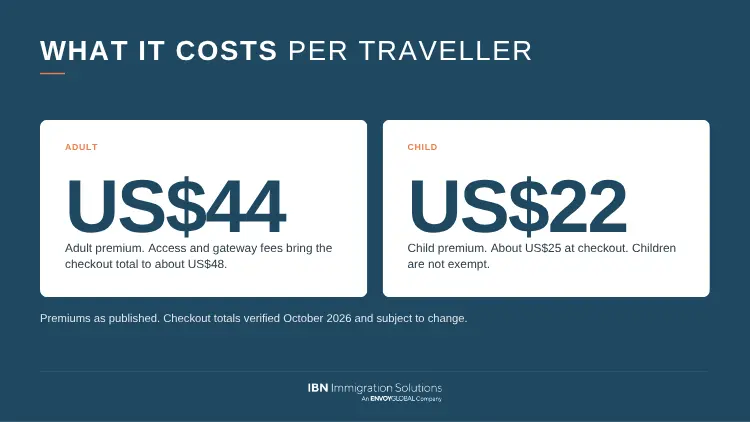
The premium is US$44 per adult traveller and US$22 per child. Additional charges apply at checkout, including a US$1 access fee and a payment gateway fee, which brought the total to approximately US$48 per adult and US$25 per child when tested in October 2026. These checkout totals have already shifted once since launch, so employers should treat the US$44 premium as the reliable planning figure and confirm the final amount at the point of payment. The policy is linked to the validity of the ETA and is generally valid for the same period, currently up to three months. Where the policy is bought separately on eCitizen, it should be obtained before the ETA application so that cover is linked at the point of authorisation.
The Debate Around the Requirement
The introduction of mandatory inbound travel health insurance has generated debate among stakeholders across Kenya’s tourism and travel sectors.
In public commentary, tourism industry leader Mohamed Hersi argued that many international travellers already hold comprehensive travel insurance policies covering medical treatment, emergency evacuation and repatriation. He questioned whether requiring visitors to purchase a Kenyan-issued policy duplicates existing cover and creates an additional cost for travellers who are already adequately insured.
Hersi also raised concerns about the impact on families, as each traveller, including children, must obtain individual coverage. Additional concerns included the requirement for airlines to verify compliance before boarding, the potential administrative burden on travellers and tour operators, and the possibility that added costs and requirements could affect Kenya’s attractiveness as a tourism and business destination.
The Ministry has defended the policy as a way of ensuring that visitors have access to healthcare when needed and reducing the financial burden on healthcare facilities when uninsured foreign nationals are unable to pay for treatment. Supporters argue that mandatory coverage provides greater certainty that medical expenses will be covered and reduces the risk of hospitals absorbing unpaid healthcare costs.
The debate therefore centres on balancing concerns about travel costs and administrative requirements with the government’s objective of ensuring that visitors have adequate medical coverage during their stay.
A Regional Trend
Tanzania implemented a comparable requirement on 1 October 2026 at a US$44 premium for stays of up to 92 days, with EAC and SADC citizens exempt, and Zanzibar has required inbound cover since October 2024.
As countries continue reviewing healthcare funding and visitor compliance measures, travel requirements are increasingly extending beyond visas and entry authorisations alone. Employers operating across multiple African jurisdictions may therefore need to monitor similar developments in other destinations.
What Should Travellers and Employers Do Now?
Travellers planning a visit to Kenya should familiarise themselves with the insurance requirement before starting the ETA application process and factor the additional cost into their travel budgets.
Employers should review their travel policies and ensure employees travelling to Kenya are aware of the requirement well before departure. Travel, HR and mobility teams may also wish to update pre-departure checklists to include verification that the required insurance has been obtained through the ETA process.
Businesses that regularly send employees to Kenya should continue monitoring official guidance for any implementation updates or clarifications, particularly as the new system becomes established in practice. That monitoring is warranted: although the October ruling upheld the requirement, a separate challenge concerning the selection of the insurers appointed to run the scheme remains before the courts, and implementation details may shift as a result.
Conclusion
Kenya’s new inbound travel health insurance requirement adds another compliance consideration for organisations sending staff into the country. While debate continues over the policy’s impact on travel costs and existing insurance arrangements, the requirement is now in force and applies to a broad range of short-term visitors, including business travellers and conference delegates.
For employers the practical step is narrow: confirm the policy is attached to the ETA before the employee flies, and budget on the US$44 adult premium plus checkout fees, currently bringing the total to roughly US$48. Until the Ministry clarifies the status of foreign policies, do not assume an existing corporate travel policy will satisfy the requirement at check-in.
Written by Tatjana Singh, Immigration Manager, Kenya