Namibia is experiencing a sustained rise in residential house prices that is no longer peripheral or cyclical. It is structural, measurable, and increasingly exclusionary.
Over the past year alone, national house prices have risen by approximately 7.8 percent year on year, a figure that has moved beyond public perception into statistical certainty. For many households, the question is no longer why prices are rising, but whether ownership remains a realistic aspiration at all.
The escalation is the result of various variables. It is the outcome of an imbalanced system where demand continues to grow while supply remains chronically inadequate. Within that imbalance, foreign and well-capitalised investors have become an amplifying force, not a singular cause, but one whose impact is magnified by Namibia’s long-standing housing constraints.

Verified Scale of the Price Increase
Transaction data compiled from Deeds Office records by FNB Namibia confirms the magnitude of the increase. The national weighted average house price rose from approximately N$1.23 million in early 2024 to over N$1.42 million by the fourth quarter of 2025. Annual growth has remained between 7 and 9 percent, consistent with the widely cited 7.8 percent increase over the past year.
These figures are not confined to upper-income neighborhoods or speculative zones. They reflect a national pattern, with the sharpest pressures evident in Windhoek and economically strategic coastal towns. The data underscores a critical point often missed in public debate.
It is a systemic shift.
Investor Inflows and the Currency Advantage
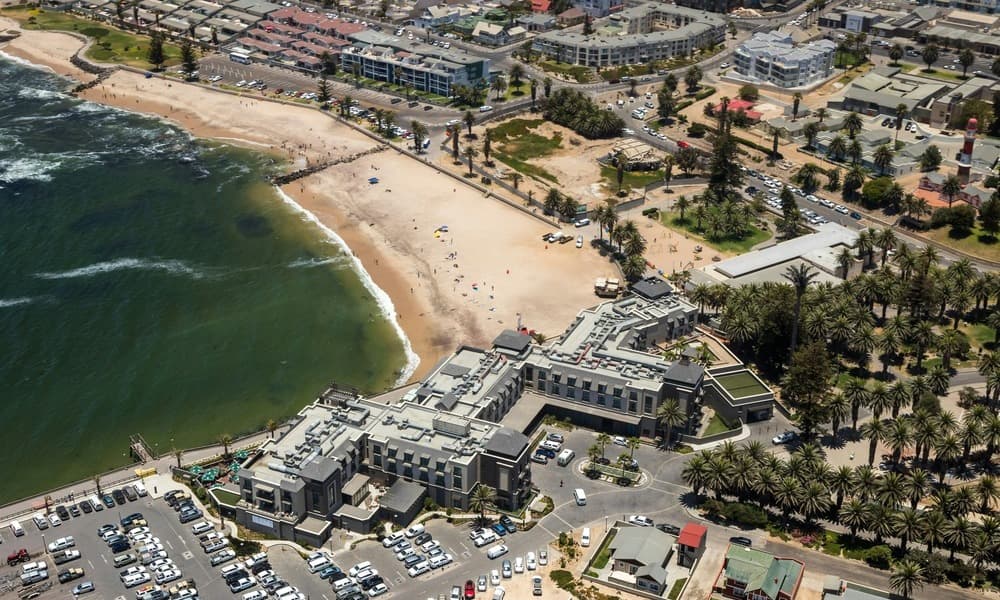
Namibia has seen renewed interest from foreign buyers and property investors, particularly in Windhoek, Swakopmund, and Walvis Bay. This coincides with post-pandemic reopening, tourism recovery, and rising rental demand in high-growth urban nodes.
For investors operating in euros, US dollars, or pounds sterling, Namibian property remains comparatively affordable. Even after recent increases, the currency differential enables foreign buyers to compete aggressively for limited stock, often at price points unreachable for local earners reliant on domestic salaries and borrowing limits.
It is important to be precise. There is no official dataset disaggregating property transactions by nationality or investor status.
As a professional in real estate, immigration, and the legal sector, I view this data gap as significant. What can be stated confidently is that financial institutions and analysts consistently identify foreign and investor activity as present and influential. The evidence supports the conclusion that investor demand intensifies existing pressure. It does not support the claim that it is the primary engine of price inflation.
The Structural Supply Deficit
Across policy institutions and financial bodies, there is unanimity on the central issue. Namibia does not have enough serviced land or housing stock.
Current estimates place the national backlog at over 300,000 serviced residential plots, a deficit acknowledged within the National Housing Policy 2023 and by the National Planning Commission. This shortage has accumulated over decades, driven by slow land servicing, funding constraints, fragmented urban planning, and limited scale in affordable housing delivery.
While new developments are visible, they do not match population growth, urbanisation, or household formation. In a system this constrained, any additional demand, whether from local households, investors, or foreign buyers, inevitably translates into price escalation. The market has no buffer.
The Reality of Housing Affordability
The social cost of this imbalance is stark. More than 87 percent of Namibian households cannot afford formal housing based on prevailing income levels and mortgage qualification thresholds.
With an average household income of around N$10,000 per month, most households qualify for loans of up to N$500,000. Against an average house price exceeding N$1.4 million, the disconnect is mathematical rather than rhetorical. At current levels, only about 2.9 percent of households can afford a N$1 million home if they are not already overindebted through other loans.
Does it matter whether investors, supply shortages, or broader economic dynamics are responsible when the result is exclusion?
The answer is yes, because remedies depend on diagnosis. Yet the lived reality remains unchanged. Investor participation in a supply-constrained system intensifies competition for homes that the majority can never afford.
Broader Urban and Economic Consequences
The impact extends beyond the property market itself. Informal settlements now house over 60 percent of urban residents, expanding as formal housing slips further out of reach. Ownership is giving way to long-term renting, particularly in urban and coastal areas where investor activity is strongest.
Rental growth provides short-term relief for accommodation, but it comes at a long-term cost. Reduced ownership limits asset accumulation, entrenches wealth inequality, and weakens intergenerational economic mobility in a country where housing remains a primary store of household wealth.
International development experience consistently shows that sustained exclusion from ownership carries profound social and economic risks. Namibia is not immune to those dynamics.
Amplification, Not Sole Causation
The evidence does not justify a simplistic narrative that blames foreign investors. Structural supply shortages are the root cause. Investor inflows and currency advantages act as powerful amplifiers within a constrained system.
Without a decisive expansion in serviced land delivery, affordable housing development, and coordinated urban planning, price pressures will persist. In such conditions, even moderate investor interest produces outsized effects.
The challenge before Namibia is therefore not merely about managing demand. It is about correcting a structural failure that has allowed housing prices to decouple entirely from local income realities. Until that failure is addressed, affordability, social inclusion, and long-term economic stability will remain under threat.
Written by Ian Coffee, Branch and Immigration Manager, Namibia